Climate change is no longer a distant threat for Cameroon’s smallholder farmers—it is a daily reality. Across the Southwest Region, increasingly unpredictable rainfall, prolonged dry spells, declining soil fertility, and emerging pest and disease outbreaks are making farming more difficult and threatening household food security and incomes.
Helping farmers adapt requires more than simply introducing new technologies. It requires equipping them with practical knowledge, strengthening their confidence to adopt improved practices, and ensuring they continue receiving technical support long after formal training has ended.
With this goal in mind, the Alliance for Sustainable Development (ASDEV), in partnership with the Pan African Climate Justice Alliance (PACJA), organized a Climate-Smart Agriculture (CSA) and Climate Information Services (CIS) capacity-building workshop in Wotutu, Fako Division, under the Climate Justice Impact Fund for Africa (CJIFA)-funded GUARD PLUS Project.
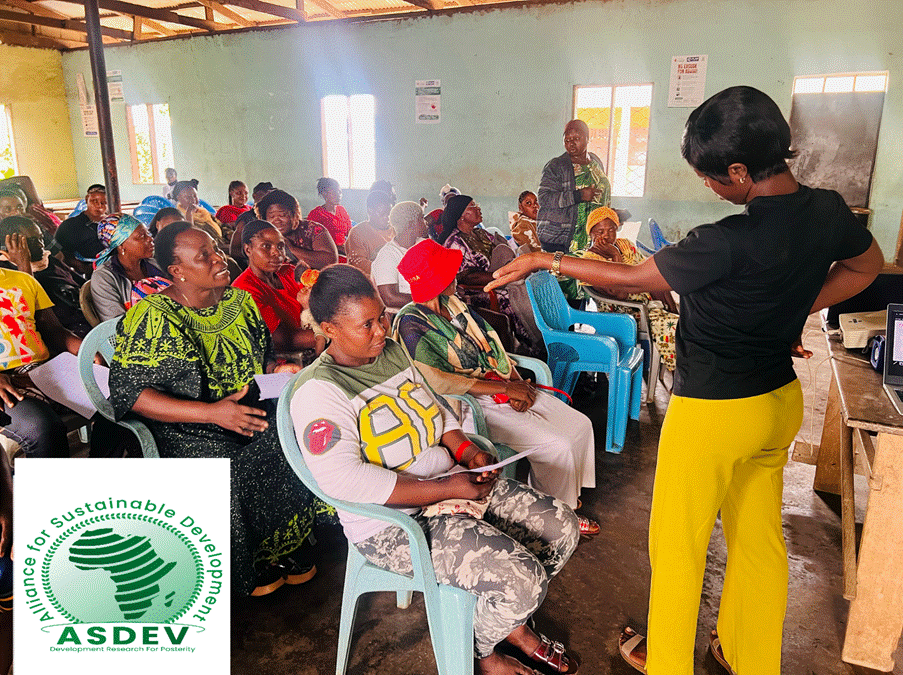
The workshop brought together more than 80 smallholder farmers for a full day of practical learning, field demonstrations, and interactive discussions designed to strengthen climate resilience and improve agricultural productivity. More importantly, the initiative combined classroom training with hands-on learning, continuous digital advisory services, and a monitoring and learning system to measure real changes in farmers’ knowledge.
Turning climate challenges into opportunities
For many farming communities in Cameroon, climate variability has disrupted long-established agricultural calendars. Planting seasons have become increasingly uncertain, while prolonged droughts and heavy rainfall events continue to reduce crop yields and increase production risks.
During the workshop a farmer had a reflection of his experiences:
“For generations, we have farmed the way our fathers farmed. But the rain no longer listens to our fathers’ calendar. We must learn new ways—or we will be left behind… Nana Joseph”
His reflection illustrates why farmer capacity development and scaling initiatives has become one of the most important investments for building resilient food systems.
Learning practical solutions for climate-resilient agriculture
The workshop was designed to provide practical solutions that farmers could immediately apply within their own production systems. Rather than relying solely on lectures, participants actively engaged with experts, shared experiences, and discussed local challenges affecting crop production.
A multidisciplinary team comprising specialists from the Ministry of Agriculture and Rural Development (MINADER), the Institute of Agricultural Research for Development (IRAD), the University of Buea, and local organizations including ACEFA delivered the training.
Participants received practical instruction on a wide range of CSA practices, including:
- Soil and water conservation practices such as terracing, mulching, and planting basins;
- Minimum tillage and crop residue retention to improve soil health;
- Integrated pest and disease management for sustainable crop protection;
- Climate-resilient crop varieties capable of performing under changing climatic conditions;
- Water harvesting and efficient water management practices;
- Cover cropping and other soil conservation techniques; and
- Sustainable agronomic practices that enhance productivity while protecting natural resources.
The workshop also introduced farmers to CIS, demonstrating how seasonal climate forecasts, rainfall onset and cessation information, weather advisories, and other climate information products can support better decisions on planting dates, variety selection, fertilizer application, and crop management.
Measuring learning through evidence
Effective capacity development should be measurable.
To assess whether the workshop achieved its objectives, ASDEV conducted a structured Monitoring and Learning Survey before and after the training. The assessment measured participants’ knowledge of Climate-Smart Agriculture practices, Climate Information Services, and recommended agronomic practices.
The post-training assessment revealed clear improvements in farmers’ understanding across the different training modules, demonstrating that practical and participatory learning approaches can rapidly strengthen farmers’ technical knowledge.
Beyond fulfilling donor reporting requirements, these findings provide valuable evidence that investments in farmer capacity development can produce measurable improvements in climate adaptation knowledge within a relatively short period.
Such evidence is critical for informing future programming and strengthening climate adaptation initiatives across Cameroon.
Farmers share their experiences
While survey results demonstrated measurable learning gains, the strongest evidence of the workshop’s impact came directly from the farmers themselves.
Learning Safer Farming Practices
Farmer Senge Lilian reflected on the importance of improving pesticide management:
“My eyes have been opened to many practices we carried out without knowing their dangers. I have learned safer ways of controlling pests and diseases.”
Her testimony highlights how access to accurate agricultural information can improve both farm productivity and farmer health.
Building new knowledge
Farmer Kango Gabriel summarized his experience simply:
“I have learned so many things today that I never knew before.”
His reflection demonstrates that even experienced farmers continue to value opportunities for practical learning.
Understanding the value of climate-smart practices
Farmer Etonjoh Anna Etoh, the training transformed an existing practice into a better-informed management strategy.
“I used planting basins before without understanding all their benefits. Now I know how to practice them correctly, and I will use them more.”
Knowledge not only encourages adoption but also improves the quality of implementation.
Looking at farming differently
Farmer Aba Dieudonne described how the workshop had changed his outlook on farming.
“There are many practices I have learned through this training that will shape the way I farm from now on—mulching, climate-smart planting basins, terracing, crop residue retention, minimum tillage, water harvesting, cover crops, drip irrigation and many others.”
His testimony reflects the broader objective of the workshop: empowering farmers to make informed decisions that strengthen resilience while improving productivity.
Extending learning beyond the workshop
Capacity development should not end when participants leave the training venue.
To provide continuous technical support, ASDEV established a dedicated WhatsApp advisory group for participating farmers.
The platform now serves as an ongoing digital extension service where farmers can:
- Receive timely weather forecasts and seasonal climate advisories;
- Access agronomic recommendations throughout the cropping season;
- Ask questions about pests, diseases, and crop management;
- Share experiences with fellow farmers; and
- Receive technical guidance from agricultural experts in real time.
By combining face-to-face training with continuous digital advisory services, the project has transformed a one-day workshop into an ongoing learning community that supports informed decision-making throughout the agricultural season.
Why This approach matters
The experience from Wotutu offers several important lessons for agricultural development practitioners, policymakers, and development partners.
First, farmers are eager to adopt improved practices when training is practical, participatory, and tailored to their local context.
Second, partnerships between government institutions, universities, research organizations, civil society organizations, and local communities significantly strengthen the quality and reach of capacity development initiatives.
Third, integrating digital advisory services into farmer training provides a practical and scalable solution for addressing the persistent shortage of agricultural extension services.
Finally, monitoring and learning systems are essential. Measuring knowledge gains allows organizations to demonstrate impact, improve programme design, and ensure accountability to both farmers and development partners.
Looking ahead
The Wotutu capacity-building workshop represents an important milestone in strengthening climate resilience among smallholder farming communities in Cameroon. Yet it is only the beginning.
Through the GUARD PLUS Project, ASDEV and its partners remain committed to expanding this model to reach more farming communities across the Southwest Region. By integrating practical training, field demonstrations, continuous digital advisory services, and evidence-based monitoring, the initiative is building the knowledge and confidence farmers need to adapt to climate change.
As climate risks continue to intensify, empowering farmers with practical skills, reliable climate information, and ongoing technical support will remain essential for improving productivity, strengthening food security, and building resilient agricultural systems.
The experience from Wotutu demonstrates that when farmers are equipped with the right knowledge, supported by strong partnerships, and connected through continuous advisory services, they are not merely adapting to climate change—they are shaping a more resilient future for themselves, their communities, and Cameroon’s agricultural sector.
Authors:
Norbert N. Ngwang
Neville N. Suh